페이퍼플라워로 구성한 슬페이퍼 핸드타이드 부케꽃을 만드는 일에서, 꽃으로 표현하는 일까지 | From Making Flowers to Expressing Through Them
페이퍼플라워 수업을 오랫동안 하면서 제가 자주 생각하게 된 것이 하나 있습니다.
꽃을 잘 만드는 것과, 그 꽃으로 하나의 작품을 만드는 것은 조금 다른 일이라는 것.
처음 페이퍼플라워를 배울 때에는 한 송이를 완성하는 것만으로도 꽤 많은 것을 배우게 됩니다. 꽃잎을 자르고, 곡선을 만들고, 중심을 표현하고, 줄기와 잎을 연결하면서 평면의 종이가 조금씩 꽃의 모습을 갖추어가는 과정을 경험하지요.
저 역시 새로운 꽃을 만들 때마다 자연스럽게 이런 것들을 고민해왔습니다.
꽃잎은 어떤 형태로 잘라야 할까.
어느 부분에 볼륨을 주어야 자연스러울까.
이 꽃의 특징을 종이로 표현하려면 무엇을 남기고, 무엇을 조금 단순하게 표현해야 할까.
그런데 수업을 하다 보면 조금 다른 장면을 만나게 됩니다. 몇 주 동안 하나씩 꽃을 배우고 만드는 일에 제법 익숙해진 수강생들도, 여러 송이를 하나의 부케로 구성하기 시작하면 한 송이를 만들 때와는 또 다른 어려움을 만나곤 했어요.
처음에는 스파이럴이라는 새로운 기술이 익숙하지 않아서 그렇다고 생각했습니다. 그런데 여러 번 수업을 하며 비슷한 모습을 지켜보다 보니 꼭 손의 기술만의 문제는 아니라는 생각이 들었습니다. 한 송이를 만들 때와 달리 부케에서는 계속 새로운 선택을 하게 되거든요. 어떤 꽃을 먼저 잡을지, 어떤 소재를 어디에 놓을지, 어떤 색을 가까이 둘지, 높이는 얼마나 다르게 할지. 그리고 때로는 정성껏 만든 꽃을 조금 뒤에 두는 선택도 필요합니다.
어쩌면 부케를 만들면서 스파이럴이라는 기술만이 아니라 페이퍼플라워의 ‘구성 자체를 처음 배우는 것인지도 모르겠습니다.
Read in English
After teaching paper flower classes for many years, there is one thought I return to again and again.
Making a beautiful flower and creating a meaningful piece with that flower are not quite the same thing.
When we first learn paper flower art, completing a single bloom already teaches us a great deal. We cut petals, shape their curves, build the center, and connect stems and leaves until a flat sheet of paper gradually takes on the form of a flower.
Whenever I create a new flower, I naturally find myself asking questions like these:
What shape should the petals take?
Where should I add volume so the flower feels natural?
Which characteristics should I preserve, and which ones should I simplify when translating this flower into paper?
But in class, I often see a slightly different moment.
Even students who have become fairly comfortable making individual flowers encounter a new kind of difficulty when they begin composing several flowers into one bouquet.
At first, I assumed this was simply because the spiral technique was unfamiliar.
But after watching the same pattern appear again and again, I began to realize that it was not only a matter of hand skills.
A bouquet requires continuous choices.
Which flower should I start with?
Which material should go where?
Which colors should sit close together?
How much variation should there be in height?
And sometimes, where should a flower I worked hard on remain quietly in the background?
Perhaps what students first encounter through a bouquet is not only a new technique, but the very idea of composition itself.
Making → Composing
한 송이를 만드는 것에서 작품을 구성하는 것으로 | From Making a Single Flower to Building a Composition
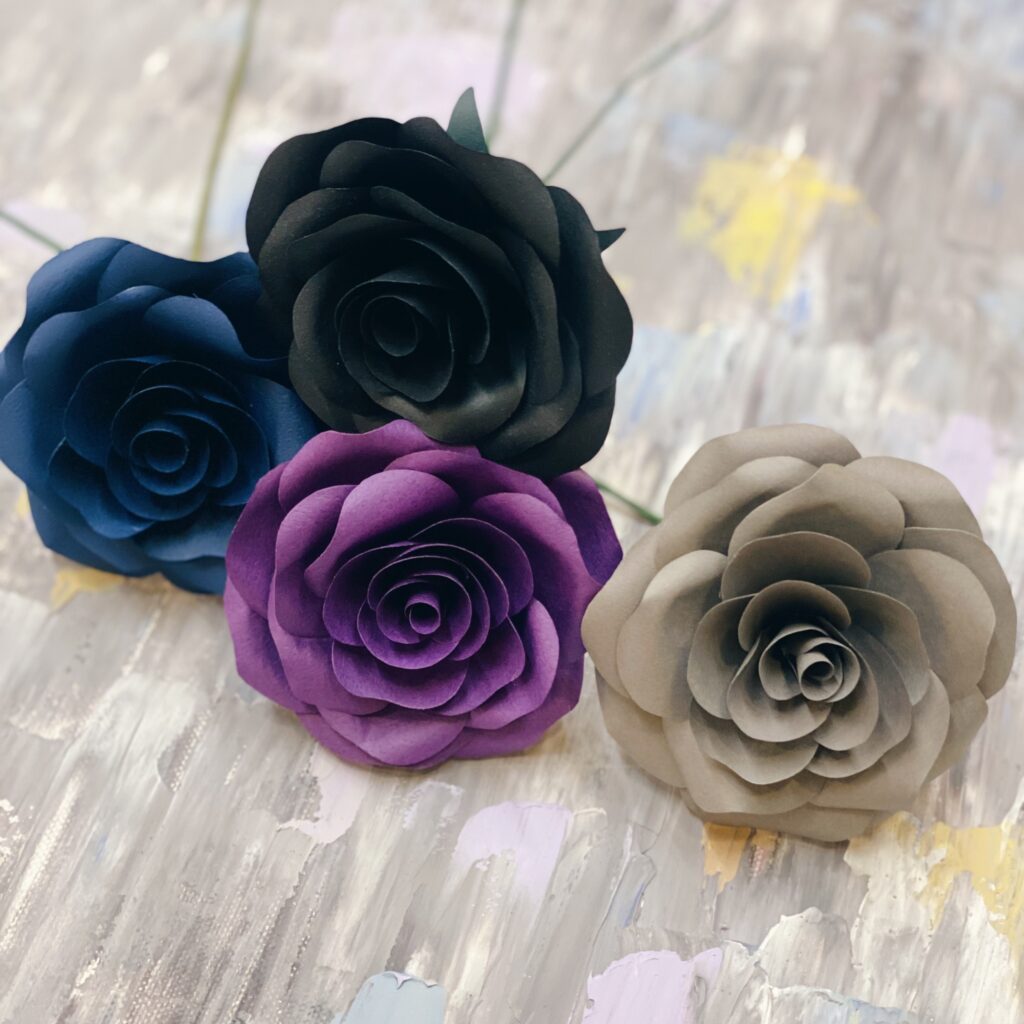
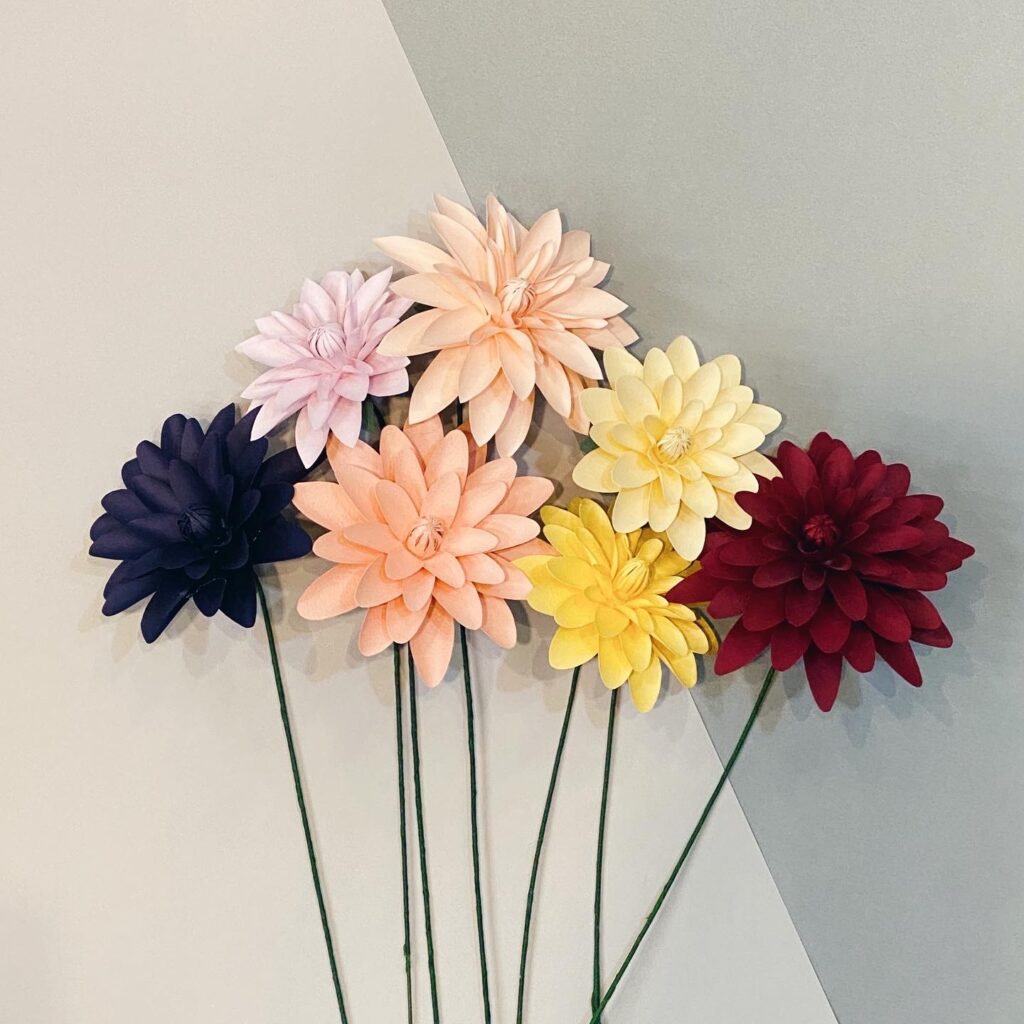
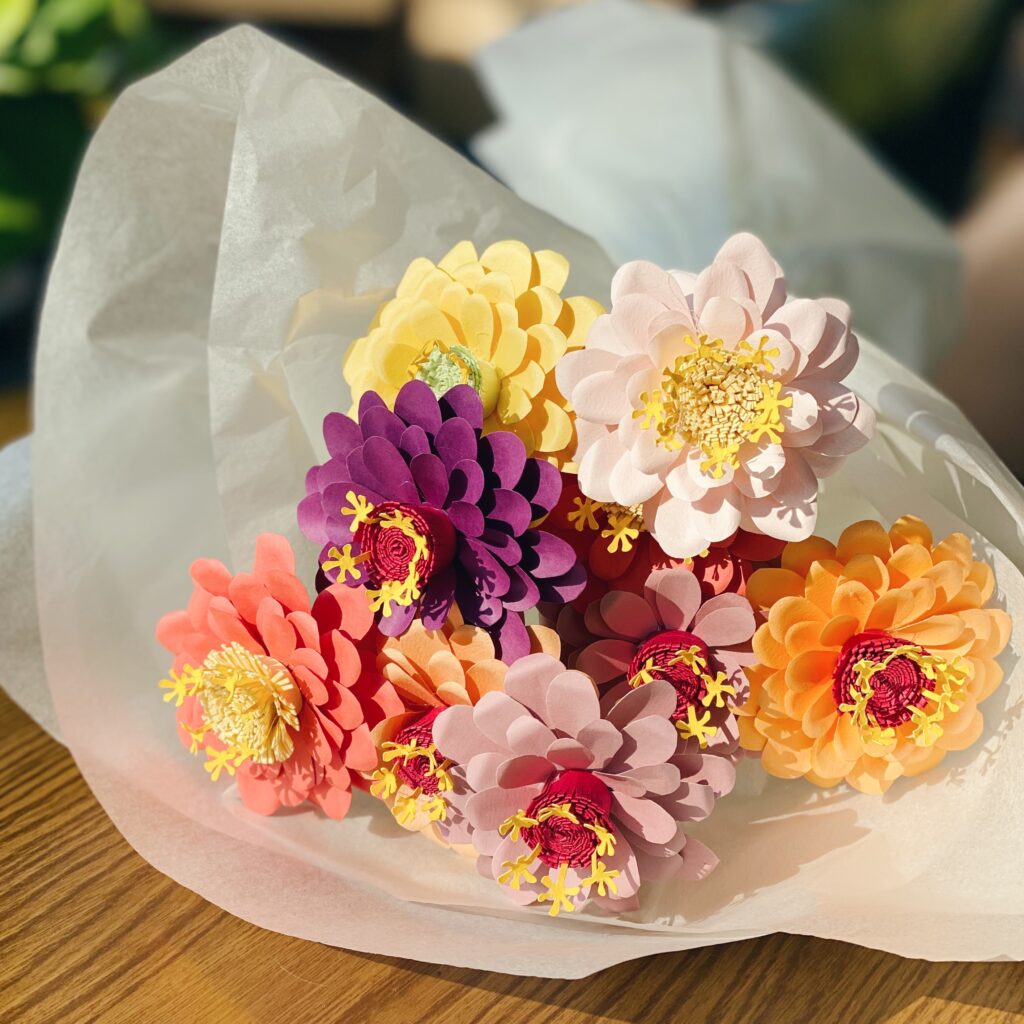
제가 처음 페이퍼플라워 자격증 커리큘럼을 만들 때 마지막 평가과제로 핸드타이드 부케를 선택하면서 수업시간에 한 송이의 꽃을 잘 만들어보는 것에서 한 걸음 더 나아가고 싶다는 생각을 했습니다. 그동안 배웠던 꽃을 다시 만들어보고, 여러 송이를 한꺼번에 놓아보고, 그 꽃들을 자신의 손으로 하나의 작품으로 구성해보는 경험까지 이어졌으면 했거든요.
실제로 부케를 준비하려면, 이전에 배웠던 꽃들을 계속 만들며 연습하게 됩니다. 그러다 보면 자연스럽게 지난 몇 주 동안 배운 기술을 다시 사용하게 되요. 꽃잎을 다루는 손도 조금씩 익숙해지고, 처음에는 어렵게 느껴졌던 꽃도 두 번째, 세 번째 만들어보면서 조금씩 자신의 것이 되어갑니다.
저는 이 반복되는 시간이 꽤 중요하다고 생각합니다. 한 번 만들어본 꽃과 여러 번 만들어본 꽃은 분명 다르거든요. 도안을 보고 순서를 따라가는 것에서 조금씩 벗어나 어느 정도의 곡선을 주어야 할지, 꽃잎을 어디에 놓아야 할지 스스로 판단하기 시작합니다.
그런데 재미있는 건 그다음부터예요. 잘 만든 꽃이 충분히 준비되어 있다고 해서 좋은 부케가 저절로 만들어지는 건 아니더라고요. 한 송이를 만들 때에는 그 꽃 하나를 잘 들여다보면 됩니다. 하지만 여러 송이를 한자리에 놓는 순간부터는 꽃 하나보다 꽃과 꽃 사이가 눈에 들어오기 시작합니다. 어떤 꽃 옆에 무엇을 놓느냐에 따라 같은 꽃도 조금 다르게 보이고, 높이를 조금 바꾸는 것만으로 전체의 흐름이 달라지기도 합니다. 작은 꽃 하나가 큰 꽃 사이를 자연스럽게 이어주기도 하고요.
그때부터 질문이 조금 달라집니다.
“이 꽃을 어떻게 잘 만들까?”에서
“이 꽃들을 어떻게 함께 놓을까?”로.
저는 이 변화가 한 송이를 만드는 것에서, 내가 만든 꽃으로 하나의 작품을 구성하기 시작하는 작은 전환점이라고 생각합니다.
Read in English
When I first designed my paper florist certification curriculum, I chose a hand-tied bouquet as the final practical assignment because I wanted the learning process to go one step beyond making individual flowers well.
I wanted students to remake the flowers they had learned, place several of them together, and experience the process of turning those separate pieces into a single composition with their own hands.
Preparing a bouquet naturally leads students to keep making and practicing the flowers they learned in previous weeks.
In that process, they begin using the same techniques again and again. Their hands become more comfortable shaping petals, and flowers that once felt difficult gradually begin to feel more familiar with the second or third attempt.
I think this repetition matters.
A flower you have made once and a flower you have made several times feel noticeably different.
Little by little, you move beyond simply following the pattern and the steps. You begin to decide for yourself how much curve a petal needs, or where a petal should sit. And then something else happens. Even when every flower has been made beautifully, a good bouquet does not simply appear on its own.
When making a single flower, you can focus entirely on that one bloom. But the moment several flowers are placed together, your attention begins to shift from the individual flower to the space between the flowers.
The same flower can look completely different depending on what sits beside it. A slight change in height can alter the entire flow of the bouquet. A small flower can gently connect two larger forms.
That is when the question begins to change.
From:
“How can I make this flower well?”
to:
“How can I place these flowers together?”
I see this as a small but important turning point: the moment we begin moving from making individual flowers to composing a work of our own.
Not Every Flower Needs to Be Seen
모든 꽃이 보여야 하는 것은 아니다 | Not Every Flower Has to Be Visible
부케 수업을 하면서 제가 참 재미있다고 느꼈던 장면이 하나 있어요.
수강생들은 자신이 만든 꽃을 정말 소중하게 생각합니다.
아주 당연하지요. 몇 주 동안 하나씩 배우고, 집에서도 다시 만들어보고, 마음에 드는 색을 골라 정성껏 준비해온 꽃들이니까요.그래서 처음 부케를 만들 때에는 가능하면 내가 만든 모든 꽃을 보여주고 싶어 해요. 한 송이가 다른 꽃 뒤에 가려지면 슬쩍 앞으로 꺼내고, 또 다른 꽃이 안 보이면 그것도 조금씩 앞으로 가져옵니다. 그 마음이 저는 충분히 이해돼요. 직접 만든 꽃인데 안 보이면 아깝잖아요. 🙂
그런데 그렇게 하나씩 앞으로 꺼내다 보면 재미있는 일이 생깁니다.
각각의 꽃은 더 잘 보이는데, 오히려 부케 전체의 균형은 조금씩 흐트러지기 시작해요. 그 모습을 여러 번 보면서 저 역시 다시 생각하게 되었습니다.
하나의 작품 안에서 모든 꽃이 같은 역할을 할 필요는 없구나.
어떤 꽃은 가장 먼저 시선을 끌어도 되고, 어떤 꽃은 두 색 사이를 조용히 연결해도 됩니다. 작은 꽃은 큰 꽃 사이에 리듬을 만들어주고, 잎이나 그린 소재는 꽃과 꽃 사이에 숨을 쉴 공간을 만들어주기도 하지요. 그리고 어떤 꽃은 다른 꽃 뒤에 조금 가려질 수도 있습니다. 정면에서 많이 보이지 않더라도 전체적인 볼륨을 만들고 있거나 옆에서 바라봤을 때 다른 꽃과 자연스럽게 이어지고 있다면, 이미 그 자리에서 충분히 자신의 역할을 하고 있는 셈입니다.
그래서 저는 부케를 만들면서 배우는 것 중 하나가 ‘모든 것을 보여주지 않아도 괜찮다는 것’이라고 생각합니다.
구성한다는 것은 모든 것을 보여주는 일이 아니라, 무엇을 보여주고 무엇을 조금 뒤에 남겨둘 것인지 선택하는 일이기도 합니다. 생각해보면 이건 부케에만 해당하는 이야기는 아닌 것 같아요. 작품을 만들 때도 자꾸 무언가를 더하고 싶은 순간이 찾아오니까요.
Read in English
There is one scene I have always found especially interesting in bouquet classes.
Students become deeply attached to the flowers they have made. Of course they do. These are flowers they have spent weeks learning, remaking at home, and preparing carefully in colors they love.
So when they make their first bouquet, they often want every flower they made to be visible. If one flower disappears behind another, they gently pull it forward. If another bloom becomes hidden, they bring that one forward too.
I understand that feeling completely. You made the flower yourself. Of course it feels a little sad when no one can see it. 🙂
But when every flower is gradually pulled toward the front, something interesting begins to happen. Each individual flower becomes easier to see, yet the balance of the bouquet begins to loosen. Watching this happen repeatedly made me think again about the role of each flower inside a composition.
Not every flower needs to play the same role.
One flower may naturally draw the eye first, while another quietly connects two colors. Smaller blooms can create rhythm between larger forms, and foliage can give the bouquet breathing room.
Some flowers may sit partially behind others. Even if they are not clearly visible from the front, they may still be creating volume or connecting the form when viewed from the side. They are already doing their job exactly where they are.
This is why one of the things I think we learn through bouquet making is that it is okay not to show everything.
Composing is not about placing every element on display. It is also about choosing what to reveal and what to leave a little further back. And when I think about it, this lesson extends far beyond bouquets. Whenever we make something, there is always a moment when we feel tempted to add just one more thing.
Editing the Composition
더하는 것만큼 덜어내는 법 | Learning to Remove as Well as Add
수업을 하다 보면 의외의 경우가 있습니다.
꽃을 정말 다양하게, 많이 만들어온 분보다 오히려 3~4종류 정도로 조금 단순하게 준비한 분이 처음 부케를 구성할 때 훨씬 수월한 경우가 있었어요. 처음에는 저도 조금 의외였습니다.
꽃이 많으면 선택할 수 있는 것도 많으니 더 풍성하고 재미있는 부케를 만들 수 있을 것 같잖아요. 그런데 선택할 수 있는 꽃과 색이 많아질수록 자연스럽게 함께 고민해야 하는 부분도 많아집니다. 반대로 꽃의 종류와 컬러를 조금 줄여보면 반복되는 형태가 눈에 들어오기 시작합니다. 어느 꽃을 중심으로 둘지 조금 더 선명하게 보이고, 색과 색의 관계를 살펴보기도 한결 편안해집니다.
이 경험은 저에게도 꽤 재미있는 생각거리를 남겼습니다.
우리는 무언가를 만들 때 자연스럽게 ‘무엇을 더하면 좋을까?’를 먼저 생각하곤 합니다. 꽃이 부족한 것 같으면 한 송이를 더해보고, 빈 곳이 보이면 작은 소재를 놓아보기도 하지요. 그런데 작품을 구성하다 보면 반대의 질문이 필요한 순간도 찾아옵니다.
“무엇을 덜어내면 좋을까?”
저에게 덜어낸다는 것은 단순히 적게 만드는 것을 의미하지는 않습니다. 내가 정말 보여주고 싶은 것이 무엇인지 조금 더 잘 보이도록 선택을 정리해가는 과정에 가깝습니다. 무엇을 반복할지, 어디에서 변화를 줄지, 어느 꽃에 가장 먼저 시선이 머물게 할지 하나씩 선택해보는 것이지요. 그래서 요즘은 이런 생각을 합니다.
꽃을 만드는 일이 손을 익혀가는 과정이라면, 꽃을 구성하는 일은 조금씩 ‘선택하는 눈’을 만들어가는 과정일지도 모르겠다고요.
그리고 그 눈은 부케 하나를 만들고 끝나는 것이 아니라, 이후 다른 작품을 만들 때도 계속 이어집니다.
Read in English
Sometimes I notice something unexpected in class.
A student who brings many different kinds of flowers may find bouquet composition more difficult than someone who prepares only three or four flower varieties in a simpler palette.
At first, this surprised me too.
It seems natural to assume that having more flowers would give you more freedom and make it easier to create a rich and interesting bouquet.
But the more choices you have, the more decisions you need to make at the same time.
When the number of flower types and colors is reduced, repeated forms begin to stand out more clearly. It becomes easier to see which flower should become the focal point, and the relationships between colors feel more manageable.
This experience left me with another question.
When we make something, we tend to ask:
“What else could I add?”
If the bouquet feels empty, we add another flower. If there is a small gap, we place another detail there.
But composition also asks us to consider the opposite question:
“What could I take away?”
For me, taking something away does not simply mean making less.
It is closer to organizing our choices so that what we really want to show can become more visible.
What should repeat?
Where should variation appear?
Where should the eye land first?
Little by little, we begin making those decisions.
These days, I often think about it this way:
Making flowers trains the hands. Composing them may be a way of training the eye to choose.
And that eye does not disappear once the bouquet is finished. It continues into every work that follows.
Translating Floral Techniques into Paper
생화의 원리를 종이라는 재료로 번역하기 | Translating the Principles of Fresh Floristry into Paper
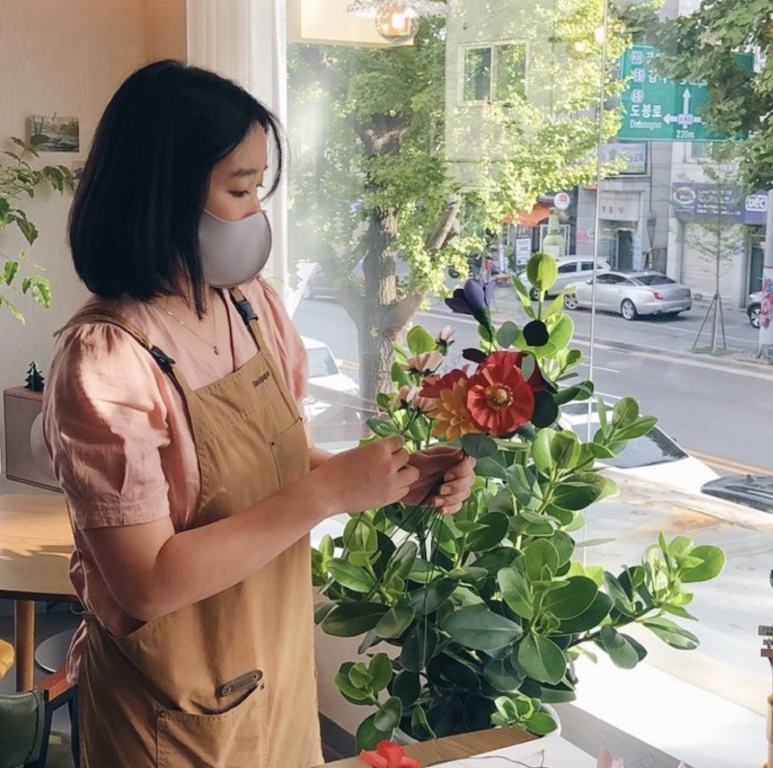
제가 핸드타이드 부케를 평가과제로 선택했던 또 하나의 이유는 페이퍼플라워를 조금 더 ‘꽃’이라는 큰 맥락 안에서 경험하게 하고 싶었기 때문입니다.
페이퍼플라워는 종이로 만들지만 우리가 관찰하고 참고하는 대상은 실제 꽃입니다. 그래서 저는 생화에서 사용하는 플라워 어레인지 기법을 페이퍼플라워에서는 어떻게 활용할 수 있을지도 함께 경험해보면 좋겠다고 생각했어요. 핸드타이드 부케에서 사용하는 스파이럴도 그중 하나에요. 줄기를 한 방향으로 비스듬히 겹쳐가며 형태를 잡는 방법인데, 설명만 들으면 단순해 보여도 처음 해보면 생각보다 쉽지 않습니다. 숙련되면 30분 안에도 충분히 마무리할 수 있는 작업이지만, 처음 경험할 때에는 여러 번 풀고 다시 잡아보면서 두 시간 가까이 부케를 완성해가기도 했습니다. 꽃 한 송이를 추가했더니 다른 꽃이 움직이고, 그 위치를 다시 조정하다 보면 전체 형태가 달라집니다. 다시 풀어보고, 잡아보고, 조금 떨어져서 바라본 뒤 또 수정합니다.
저는 그런 시간도 부케를 배우는 과정의 일부라고 생각합니다. 그리고 스파이럴을 처음부터 완벽하게 해내는 것이 이 과제의 최종 목표라고 생각하지도 않았어요. 스파이럴은 기술의 영역이기 때문에 계속 경험하고 연습하다 보면 조금씩 손에 익게 됩니다.
오히려 제가 함께 보여주고 싶었던 것은 생화에서 사용하는 원리를 종이라는 다른 재료에서는 어떻게 적용할 수 있는가였습니다.
생화와 종이는 아주 달라요. 생화에는 원래부터 줄기의 굴곡과 무게가 있고, 꽃이 고개를 드는 방향도 어느 정도 정해져 있습니다. 반면 페이퍼플라워는 만드는 사람이 꽃의 크기와 방향, 줄기의 길이와 강도까지 훨씬 적극적으로 결정할 수 있습니다. 그러니 같은 스파이럴 기법을 사용하더라도 결과는 조금 다를 수밖에 없습니다. 그 차이를 직접 경험하다 보면 자연스럽게 이런 질문을 만나게 됩니다.
“이 방법을 종이에서는 어떻게 사용하면 좋을까?”
저는 이 질문을 좋아합니다. 생각해보면 제가 페이퍼플라워를 만들면서 계속 해온 질문과도 닮아 있기 때문이에요. 실제 꽃을 종이로 똑같이 복제하기보다, 먼저 그 꽃에서 제가 무엇을 보았는지를 생각해요. 꽃잎의 곡선일 수도 있고, 여러 장이 겹치면서 만들어지는 리듬일 수도 있습니다. 줄기가 뻗어가는 방향이나 꽃이 가진 독특한 색의 변화가 마음에 남을 때도 있고요. 그리고 그 특징을 종이가 가진 색과 평면성, 질감과 구조 안에서 다시 표현해봅니다.
그래서 저에게 페이퍼플라워는 자연을 그대로 복제하는 작업이라기보다, 자연에서 발견한 형태와 원리를 ‘종이라는 언어’로 다시 해석해보는 작업에 조금 더 가깝습니다. 부케에서 사용하는 스파이럴은 어쩌면 그 생각을 직접 경험해볼 수 있는 작은 예인지도 모르겠습니다.
Read in English
Another reason I chose the hand-tied bouquet as a final assignment was that I wanted students to experience paper flowers within the broader context of flowers themselves.
Paper flowers are made from paper, but the forms we observe and study come from real flowers.
So I wanted students to explore how techniques from fresh floral arrangement might be adapted to paper flower work.
The spiral technique used in hand-tied bouquets is one example.
The stems are held diagonally in the same direction to build the overall form. It sounds fairly simple when explained, but it can be surprisingly difficult the first time.
Once someone becomes comfortable with it, a bouquet may be completed in under thirty minutes. But when students first encounter the technique, they may spend nearly two hours repeatedly releasing the bouquet, rebuilding it, and slowly finding the final form.
Add one flower and another moves. Adjust that flower and the whole silhouette shifts. So you loosen your grip, gather the stems again, step back, look, and adjust once more.
I see that time as part of learning the bouquet.
And I never considered mastering the spiral perfectly on the first try to be the ultimate goal of the assignment.
The spiral is a technical skill. With continued experience and practice, it naturally becomes more familiar.
What mattered more to me was giving students the opportunity to experience how a principle used in fresh floristry changes when it moves into another material: paper.
Fresh flowers and paper are very different.
A fresh flower already has the natural curve and weight of its stem, and its head naturally faces in a certain direction. With paper flowers, the maker can decide much more actively: the size of the bloom, the direction it faces, the length and strength of the stem.
So even when the same spiral principle is used, the result cannot be exactly the same.
That difference naturally leads to another question:
“How should this method work in paper?”
I love this question.
It feels very similar to the question I have been asking throughout my years of making paper flowers.
Rather than trying to reproduce a real flower exactly in paper, I first think about what I noticed in that flower.
Maybe it is the curve of the petals.
Maybe it is the rhythm created as layers overlap.
Sometimes it is the direction of the stem, or a subtle shift in color that stays with me.
Then I try to interpret that quality again through the color, flatness, texture, and structure of paper.
For me, paper flower art is therefore less about reproducing nature and more about interpreting the forms and principles I discover in nature through the language of paper.
The spiral technique used in a bouquet may simply be one small way of experiencing that idea with our hands.
Building a Color Vocabulary
반복되는 선택에서 나만의 색 언어 발견하기 | Discovering a Personal Language of Color Through Repeated Choices
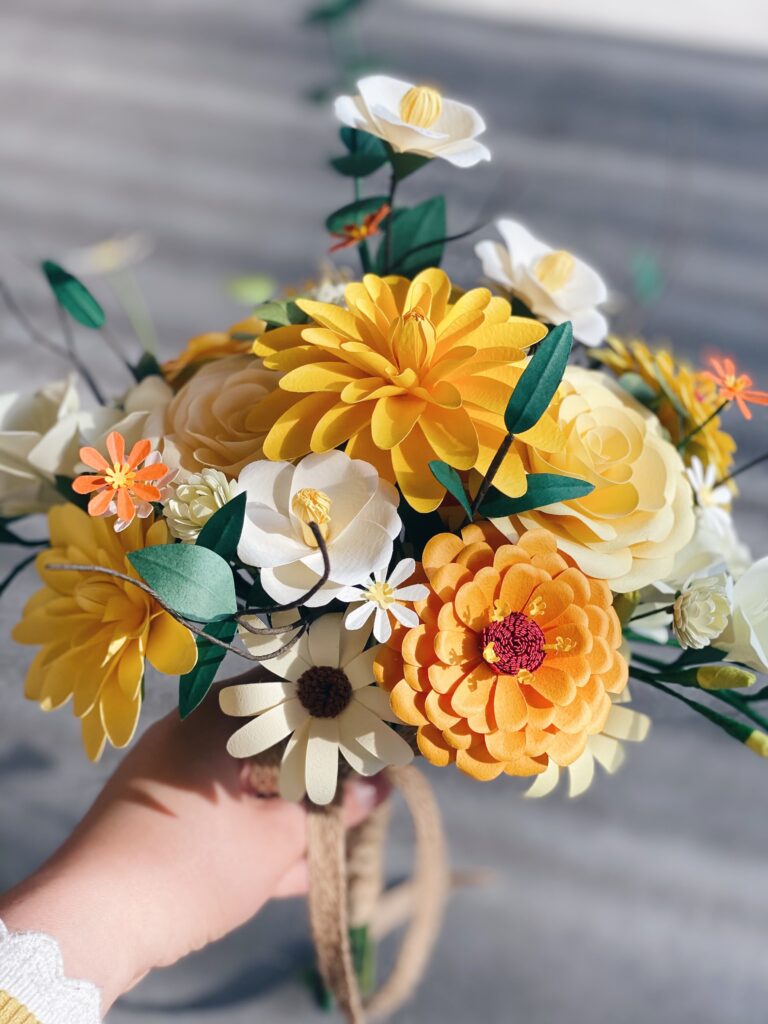
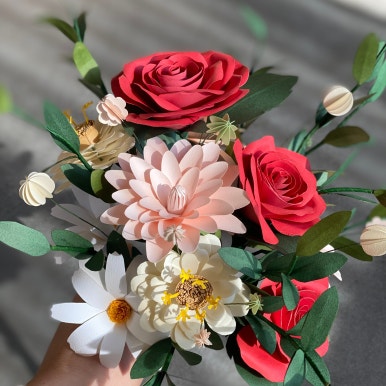
제가 오래전부터 페이퍼플라워 수업에서 자주 사용하는 말이 있습니다.
‘자신만의 컬러차트를 만들어보세요.’
처음에는 정말 색을 고르는 이야기에서 시작했습니다. 페이퍼플라워는 어떤 색지를 선택하느냐에 따라 같은 도안으로 만든 꽃도 분위기가 굉장히 달라집니다. 처음 배우는 분들은 레퍼런스의 색을 그대로 따라가기도 하고, 제가 사용한 색을 물어보기도 합니다.
그런데 꽃을 계속 만들다 보면 조금씩 달라져요. 제가 알려드린 색에서 한 걸음 더 나아가 자신이 좋아하는 색을 고르기 시작합니다. 그리고 재미있게도 그 선택에는 반복이 생깁니다. 같은 빨강 중에서도 유독 자주 손이 가는 빨강이 있고, 어떤 핑크 옆에 어떤 그린을 놓았을 때 마음에 드는지도 조금씩 알게 됩니다. 색을 선택하고 조합하는 과정에 대해서는 이전에 블루 컬러를 다룬 글에서도 조금 더 깊이 이야기한 적이 있습니다.
이전 작품에서 마음에 들었던 조합을 기억했다가 다음 작품에서 다시 사용해보기도 하고, 익숙하게 사용하던 색에 새로운 색을 하나 더해보기도 합니다. 그런 모습을 보면서 저는 많이 만들어보는 일이 단순히 손이 빨라지는 것만을 의미하지 않는다는 생각을 하게 됐습니다.
많이 만들어볼수록 자신이 무엇을 좋아하는지도 조금씩 알게 됩니다.
그리고 부케에서는 그 취향이 한 송이를 만들 때보다 훨씬 선명하게 보여요. 여러 꽃과 여러 색을 한꺼번에 놓고 직접 선택하고 구성해보게 되니까요. 같은 꽃을 배우고 같은 도안을 사용했는데도 마지막에 완성된 부케는 사람마다 꽤 다른 분위기를 갖습니다. 저는 그게 참 재미있어요. 그래서 제가 말해왔던 ‘자신만의 컬러차트’는 단순히 좋아하는 색을 모아놓은 표가 아니거라 생각해요.
반복해서 만들고 선택하면서 조금씩 생겨나는, 자신만의 Color Vocabulary, 색의 언어.
어떤 색을 좋아하는지 알아가는 것에서 시작해서, 조금씩 나는 어떤 색으로 내 작업을 표현하고 싶은지 발견해가는 과정이라고 생각하면 더 정확하지 않을까 생각이 됩니다.
Read in English
There is a phrase I have used in my paper flower classes for a long time:
“Try building your own color chart.”
At first, I meant it quite literally.
Paper flowers can look completely different depending on the paper color you choose, even when they are made from exactly the same pattern.
Beginners often follow the colors in a reference image or ask me which colors I used.
But after making flowers for a while, something begins to change.
They start moving beyond the colors I suggested and choosing colors they personally like.
And interestingly, those choices begin to repeat.
Even within red, there may be one red they keep returning to. They begin to notice which green feels right beside a certain pink. A color combination they loved in one piece may appear again in the next, and sometimes a familiar palette expands with one unexpected new color.
Watching this happen made me realize that making many flowers does not simply make the hands faster.
The more we make, the more clearly we begin to understand what we like.
And in a bouquet, that preference becomes even more visible than it does in a single flower.
You are choosing and composing several flowers and several colors at once.
Even when students learn the same flowers and use the same patterns, their finished bouquets often have very different moods.
I love seeing that difference.
It has made me wonder whether the “personal color chart” I have talked about for years is really more than a chart of favorite colors.
Perhaps it is something that gradually forms through repeated making and choosing:
a personal Color Vocabulary, a language of color.
It begins with discovering which colors you like, and slowly develops into discovering which colors you want to use to express your own work.
From Composing to Expressing
부케 이후, 내가 만든 꽃으로 무엇을 표현할 것인가 | After the Bouquet: What Do I Want to Express with the Flowers I Make?
처음 자격증 커리큘럼을 만들 때 기본과정의 마지막 평가를 두 가지로 구성했습니다.
하나는 그동안 배운 꽃을 하나의 작품으로 완성하는 핸드타이드 부케, 그리고 다른 하나는 자신이 만든 결과물을 상품으로 발전시켜 생각해보는 상품화 포트폴리오였습니다. 지금 다시 생각해보면 제가 두 과제를 함께 넣었던 이유가 꽤 분명했던 것 같아요.
꽃 한 송이를 잘 만드는 것에서 한 걸음 더 나아가기를 바랐던 겁니다.
배운 꽃을 계속 만들어보면서 조금씩 자신의 것으로 만들고, 그 안에서 좋아하는 색을 선택하고, 여러 송이를 하나의 작품으로 구성해보고, 그렇게 만든 결과물을 다른 사람에게 어떻게 보여줄지도 생각해보는 것. 제가 수강생들과 함께 경험하고 싶었던 것은 어쩌면 그 전체 과정이었던 것 같습니다. 그래서 저에게 핸드타이드 부케는 여전히 재미있는 위치에 있습니다. 분명 수업의 마지막 평가과제인데, 제가 보기에는 오히려 그다음 질문이 시작되는 지점에 더 가깝거든요.
처음에는 “이 꽃을 어떻게 만들까?”를 고민합니다.
그러다가 여러 송이를 만들게 되면 “이 꽃들을 어떻게 구성할까?” 를 생각하기 시작합니다.
그리고 저는 그다음 질문이 가장 재미있습니다.
“그렇다면 내가 만든 꽃으로 무엇을 표현할까?”
부케 다음에는 센터피스가 될 수도 있고, 벽을 위한 작품이 될 수도 있습니다. 더 나아가 공간 전체를 채우는 페이퍼플라워 설치로 이어질 수도 있겠지요. 하지만 꼭 작품의 크기가 커져야 다음 단계라고 생각하지는 않습니다. 오히려 중요한 변화는 조금씩 자신의 선택을 하기 시작한다는 것이라고 생각합니다.
어떤 꽃을 만들지, 어떤 색을 사용할지, 무엇을 앞에 놓고 무엇을 뒤에 남길지. 무엇을 더하고 무엇을 덜어낼지. 그 선택들이 하나둘 쌓이면서 조금씩 자신의 작업이 만들어집니다. 그리고 그때부터 종이는 단순히 꽃을 만드는 재료에서 조금 다른 것이 됩니다.
내가 보고 느끼고 생각한 것을 표현하는 하나의 언어가 됩니다.
아마 그래서 제가 계속 Paper as Your Story라는 말을 슬로건으로 사용하고 있는지도요.
한 송이의 꽃을 만드는 법을 배우는 것이 시작이라면, 그 꽃들을 가지고 무엇을 이야기할지 고민하는 것. 저에게는 그곳에서부터 페이퍼플라워의 또 다른 재미가 시작될거에요.
함께 보면 좋은 글
실제 수업에서 핸드타이드 부케를 어떻게 배우고 완성해가는지에 대한 이야기는 네이버 블로그의 페이퍼플라워 자격증 수업 기록에서 조금 더 자세히 소개해두었으니 참고해주세요:)
Read in English
When I first designed the certification curriculum, I created two final assignments for the foundational course.
One was a hand-tied bouquet, where students brought together the flowers they had learned into a single finished work.
The other was a product-development portfolio, where they considered how a handmade result might be developed and presented as a product.
Looking back now, I think the reason I chose those two assignments together is quite clear.
I wanted the learning to go one step beyond making a beautiful individual flower.
To keep making what they had learned until it gradually became their own.
To choose colors they genuinely liked.
To compose several blooms into one piece.
And then to think about how that work might be shown and presented to someone else.
Perhaps what I really wanted students to experience was that entire progression.
This is why the hand-tied bouquet still occupies such an interesting place for me.
It is certainly the final practical assignment of the course, but to me it feels even more like the point where the next question begins.
At first, we ask:
“How do I make this flower?”
After making several flowers, we begin asking:
“How do I compose these flowers?”
And the question I find most interesting comes after that:
“What do I want to express with the flowers I have made?”
After a bouquet, the next work might become a centerpiece, a wall piece, or even a large-scale paper flower installation that fills an entire space.
But I do not think the next stage is defined by making something larger.
The more important change is that we begin making our own choices.
Which flowers will I make?
Which colors will I use?
What will I bring forward, and what will I leave behind?
What will I add, and what will I remove?
As those choices accumulate, our own work gradually begins to emerge.
And at that point, paper becomes something slightly different from simply a material for making flowers.
It becomes a language for expressing what I see, feel, and think.
Perhaps that is why I continue to use the phrase Paper as Your Story as Seulpaper’s motto.
Learning how to make a single flower is a beginning.
The next beginning is asking what story we want to tell with the flowers we have made.
For me, that is where another kind of joy in paper flower art begins.
Paper as Your Story, Seulpaper.